
Move over, quiet luxury—conscious consumption is the new flex.
Why Climatarian Fashion Is the Only Trend That Matters
- Gen Z is boycotting Shein while thrifting vintage Levi’s.
- Millennials are investing in 30-wear pieces instead of 30-day trends.
- Boomers are mending and upcycling like it’s the ‘60s.
And the numbers don’t lie:
- Fashion is the second-largest consumer of water, while being responsible for 10% of global CO₂ emissions (more than international flights and maritime shipping).
- 85% of consumers would pay more for greener products.
But with a world culture that promotes overconsumption, conscious choices are often drowned out. Enter this handy guide to help you peel back the layers of consumerism and start your eco-chic life.
Your No-BS Guide to a Low-Carbon Wardrobe
1. Start With What You Own
If you don’t know it yet, your greenest garment is the one already in your closet. Don’t roll your eyes just yet, hear me out…
If you need ideas to restyle your clothes, the Save Your Wardrobe app can help you get a fresh perspective. It uses AI to help you minimize impulse consumption by tracking wears, suggesting outfit remixes, and providing users in certain areas with a conscious repair network.
There’s a long list of other apps that can help you approach your wardrobe with fresh eyes, build an eco-conscious community or get a professional stylist’s opinion. Before you build another online cart, checkout Acloset (to organize and reimagine your wardrobe), Indyx (for outfit ideas and personal styling), and Whering (for inspiration and to share your style with friends).
And if you absolutely must buy something, try this idea for a minimalist and conscious lifestyle. For every new item, donate or sell another, this is called the “One In, One Out” rule.
2. Fabric Cheat Sheet
Knowledge is power for conscious consumers, and knowing what you’re wearing should be at the top of your priority list.
Take a screenshot of this table, so you know which fabrics to look out for.
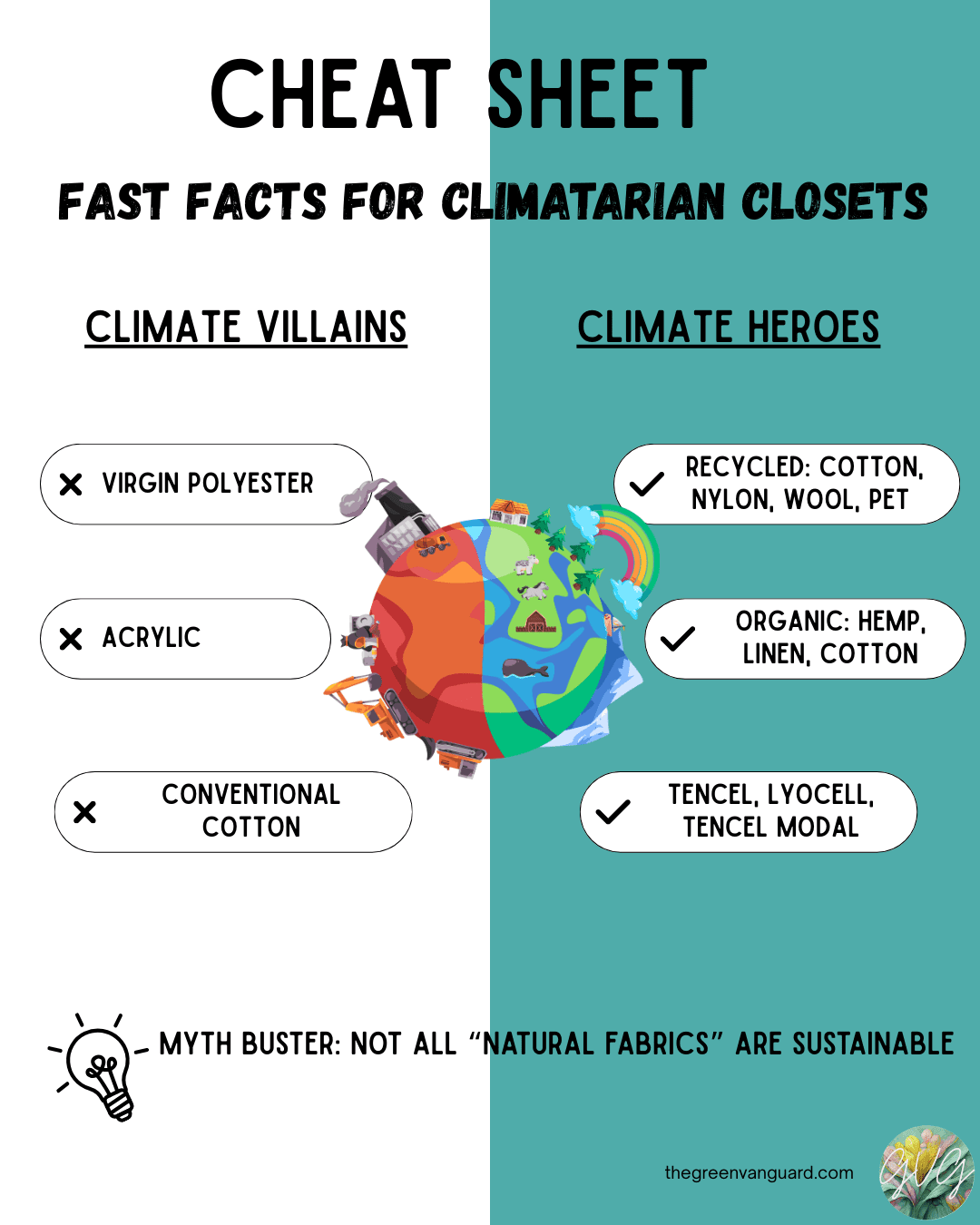
We often assume that “natural fabrics” are eco-conscious, but that is not always the case. Take bamboo—its potentially damaging impact is regularly overlooked. However, not all bamboo is created equal. Unless it’s FSC-certified or OEKO-TEX® approved, it may be causing environmental harm and contributing to deforestation.
Ultimately, buying can’t always be avoided, but how or what you buy makes an immense difference.
3. The 5-Question Pre-Buy Checklist
You can “Add to Cart,”—some of us even self-soothe this way—but before you “Checkout,” ask yourself:
- Can I rent or borrow this? Try services like Nuuly (US), Rent the Runway (US), HURR( UK), The Volte (AUS), Air Closet (Japan), Style Rotate (RSA), R’Frique (RSA).
- Is it made with low-impact materials? Check our cheat sheet above.
- Will I wear it 30+ times? If not, it’s probably an environmentally harmful fling (second-worst kind).
- Can I recycle or compost it later?
- Does the brand disclose its supply chain or carbon impact? No transparency = red flag.
Climatarian Fashion Brands Walking the Talk
As we become more conscious of the environment, brands are upping their greenwashing game. It can get a little confusing, so we’ve put together a list of sustainable brands for climatarian fashionistas (it’ll catch on, I swear).
US
Patagonia—uses lower impact materials, anti-fast fashion
Reformation—trendy, water efficient production
UK
People Tree—low impact materials, and minimal waste
Ninety Percent—has a buy one, donate one giving back model
Africa
Tongoro (Senegal)—on-demand production minimizes waste
MaXhosa (SA)—luxury brand using local and ethically sourced mohair and merino wool
Hamaji Studio (Kenya)—handmade fabrics from natural fibers