

Forget eco-friendly textiles. Future fabrics are steering fashion from “less harm” to net good.
From smart fabrics that sense your body to regenerative wool that heals the soil—the next generation of sustainable fashion innovation is alive, responsive, and sometimes grown in labs. Let’s unpack three innovations weaving their way into wardrobes worldwide.
1. Smart Fabrics: When Clothes Start Thinking
Imagine leggings that monitor your movement or a jacket that warms up when the temperature drops—no app required. That’s what happens when technology meets textiles.
Smart fabrics are materials that respond to changes in temperature, light, or motion, often using sensors, conductive threads, or embedded microchips.
Some even power themselves with body heat or solar energy. And yes, most are machine washable since the tech is woven into the fiber, not glued on top.
So, who’s leading the Smart Fabric Race?
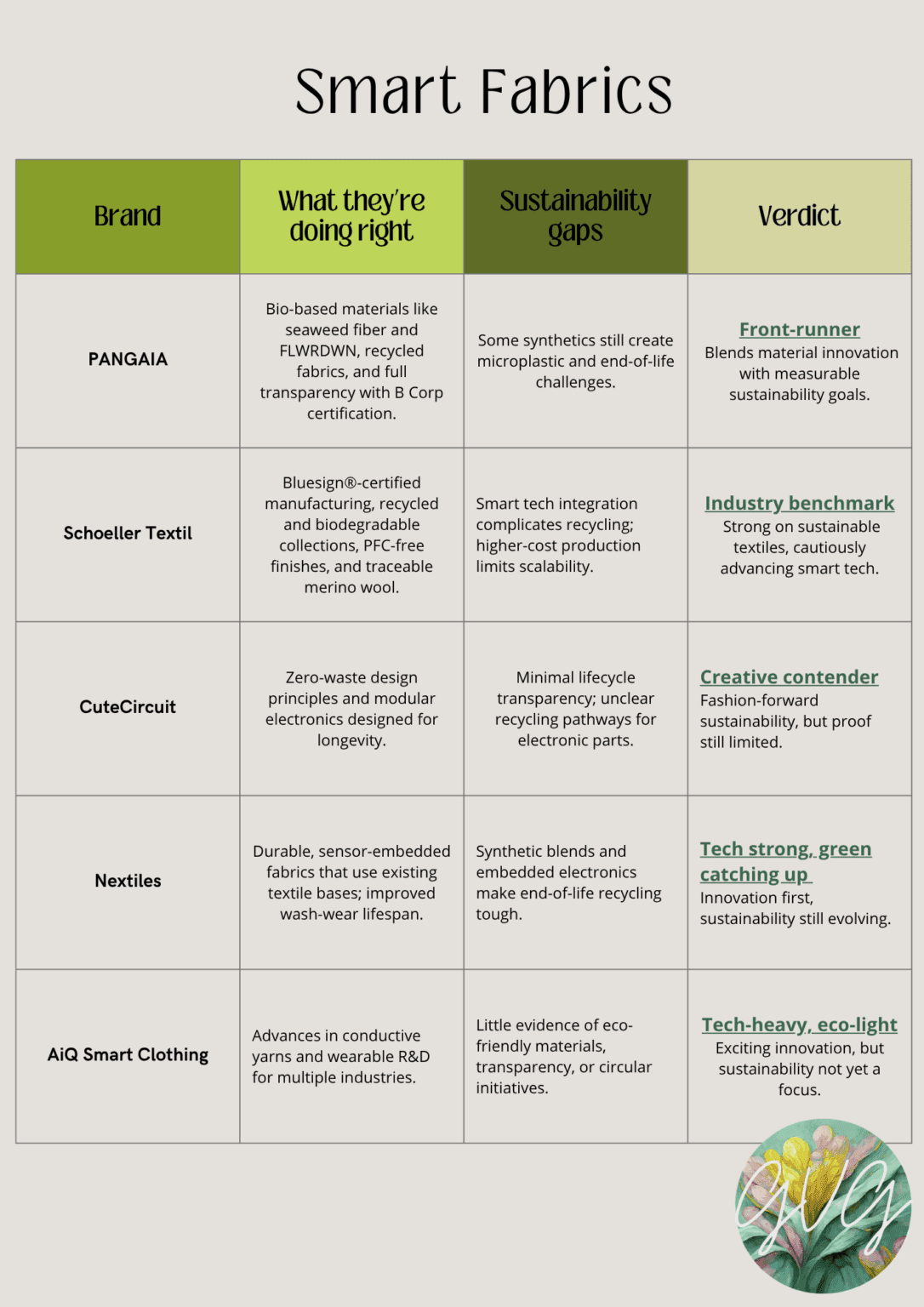
What this means for the everyday wearer:
- CuteCircuit, one of the pioneers of wearable tech, creates garments that light up, change color, or respond to movement—merging fashion and function in real time.
- PANGAIA’s latest plant-based line uses fibers made from castor beans and seaweed, cutting dependence on petroleum-based synthetics.
- We aRe SpinDye replaces traditional wet dyeing by embedding color pigments into the polyester (before fibre extrusion), which can eliminate many water-heavy steps and reduce water use by up to 75%, chemicals as much as 90%, and energy by 25-40%. Colorfastness also improves significantly.
Why it matters:
Smart fabrics could extend the lifespan of clothes (less washing, more adaptive use) and merge utility with sustainability.
Eventually, they’ll help us buy less but better — one smart garment could replace several single-purpose ones.
Reality check: Not all smart fabrics are automatically sustainable. Embedding sensors or conductive fibers can increase energy use and complicate recycling. The real sustainability comes from how the tech is integrated, like PANGAIA’s use of plant-based fibers or We aRe SpinDye’s waterless color process that cuts water and energy use.
The smartest fabrics of the future will be both tech-enabled and circular. They will extend wear life without creating new waste streams. But technology isn’t the only revolution. While some fabrics are getting smarter, others are actually healing the planet.
2. Regenerative Textiles: Future Fabrics That Heal the Earth
You’ve heard “organic cotton.” Now meet its overachieving cousin, regenerative cotton.
Instead of simply avoiding pesticides, regenerative farming actively rebuilds soil, increases biodiversity, and stores more carbon than it releases. The same goes for regenerative wool and linen — it’s farming that gives back.
What “regenerative” means in plain English:
Think of it as giving more than you take.
- For cotton: farmers rotate crops, plant cover crops, and compost waste to keep soil fertile.
- For wool: sheep graze in ways that nourish grasslands instead of degrading them.
- For you: it means your clothes come from farms that improve the planet’s health instead of draining it.
Brands walking the talk…
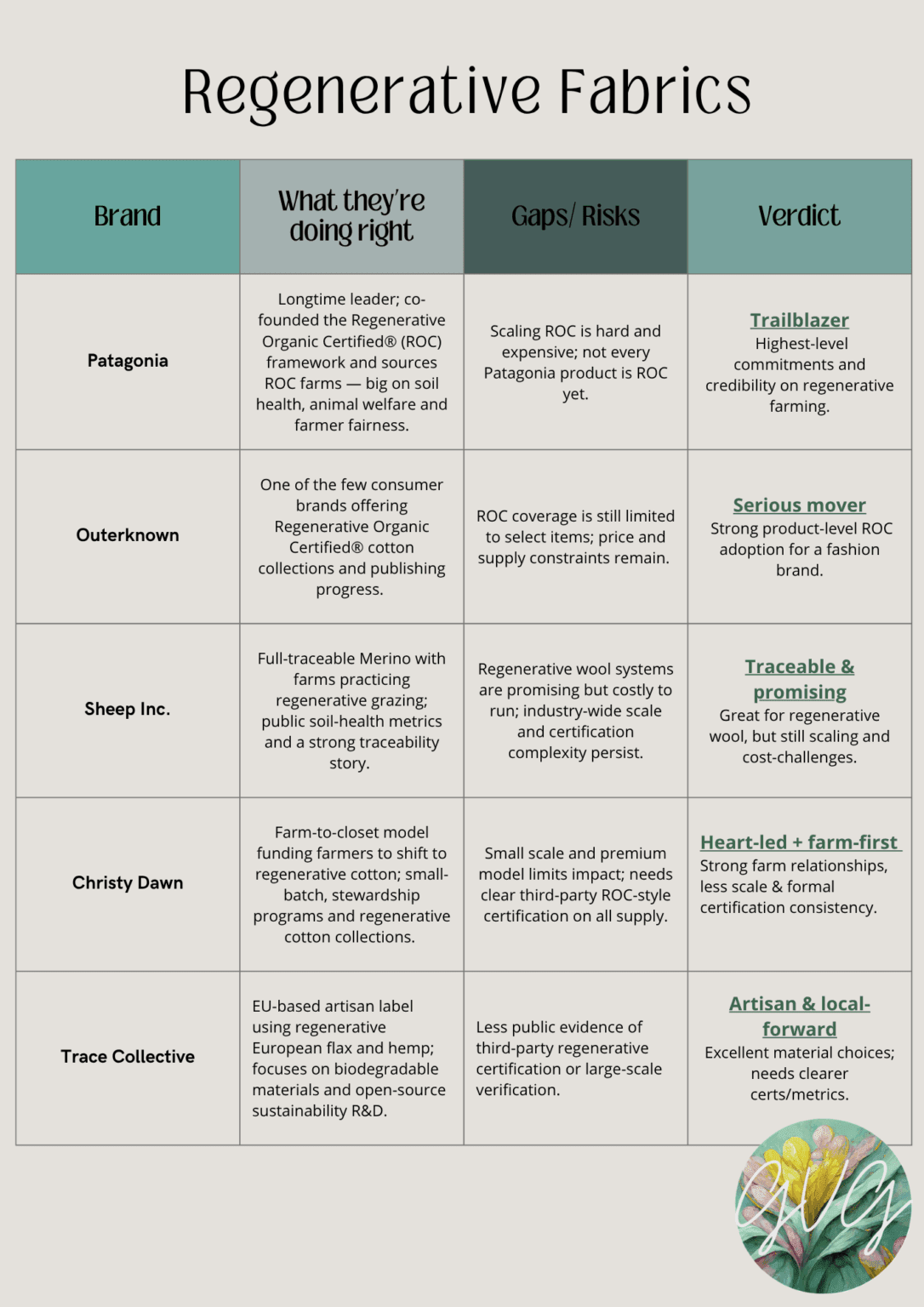
Bonus: Many of these brands now use Regenerative Organic Certified (ROC) cotton, which is the gold standard for soil health, fair pay, and traceable supply chains.
The catch: These aren’t fast fashion prices. Regenerative practices take time, land, and investment, which means higher costs at checkout. But as farms scale and share knowledge, accessibility is improving. And the long-term payoff? A textile industry that actually restores ecosystems instead of destroying them.
3. Biofabricated Materials: The Rise of Lab-Grown Fashion
If regenerative fabrics heal the planet, biofabricated materials could reinvent it. These future fabrics are grown, not extracted—made from mushrooms, algae, or even bacteria.
Mycelium leather (yes, made from mushrooms) is leading the charge. It looks and feels like animal leather, but without the cows, cruelty, or chemical tanning. And these aren’t sci-fi experiments, they’re scaling up, fast.
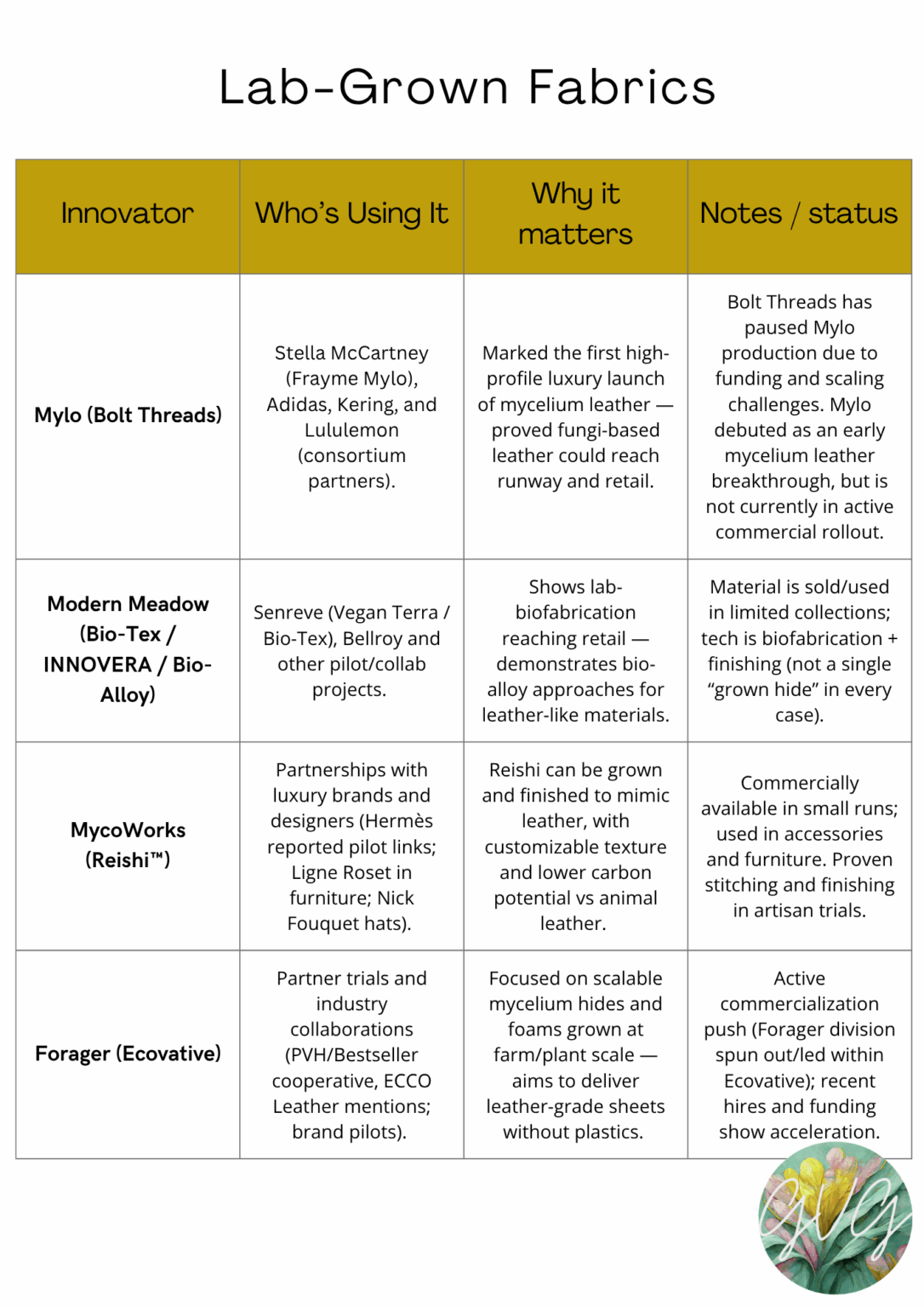
Checkout the global innovators in next-gen materials:
The Layman’s Version
Mylo was tested by Stella McCartney, Adidas, and Hermès before pausing in 2024. It managed to prove that mushroom leather isn’t just a lab experiment.
Forager and Modern Meadow are growing leather-like materials from proteins, skipping animal hides entirely.
Why It Matters for Eco-Friendly Fashion
- Handbags grown from fungi, not farms.
- Sneakers and accessories designed to biodegrade (though backing layers are still evolving).
- Clothes that minimize or eliminate microplastic shedding.
These materials are real and hitting luxury shelves or pilot collections — though most are still early-stage. Mylo made the splash but is currently paused.
MycoWorks and Ecovative are shipping small commercial runs. Modern Meadow’s bio-textiles appear in limited collections. This isn’t distant science fiction, it’s on catwalks and moving into early retail.
What This Actually Looks Like
These next-gen fabrics aren’t locked behind lab doors, they’re entering stores and pre-orders.
Here’s what you can buy (or soon will):
- Stella McCartney’s Mylo Bag: the first real luxury item made from mushroom leather
- PANGAIA’s 365 Plant-Based Activewear: crafted from castor bean nylon and bio-elastane
- Senreve x Modern Meadow: handbags made with Bio-Tex™, a lab-grown leather alternative
- Sheep Inc. Hoodies: traceable regenerative Merino wool that comes with a digital “sheep tag” to track the farm
- Patagonia’s ROC Cotton Tees: proof that regenerative farming can scale sustainably
And it’s not just luxury… Adidas and Lululemon are prototyping smart or biofabricated materials, while Christy Dawn’s “farm-to-closet” model is inspiring a generation of regenerative designers.
Soon, a single outfit might mix all three innovations:
A PANGAIA tee (plant-based nylon), a Sheep Inc. hoodie (regenerative wool), and bio-leather sneakers.
Smart, restorative, and lab-grown—the future wardrobe is already in beta.
Why This Matters
Fashion has always been about reinvention, but this time, it’s molecular.
These innovations don’t just change how we dress, they redefine fashion’s footprint:
- Smart fabrics extend lifespan and reduce waste.
- Regenerative farming turns supply chains into climate solutions.
- Biofabrication decouples beauty from extraction.
Not every “bio-based” claim holds up under scrutiny, but these brands have receipts.
It’s not about guilt anymore. It’s about wearing the future, responsibly.
Pro Tip: Want to spot next-gen fabrics IRL?
Follow @Biofabricate, @TheGoodTrade, and @CollectiveFashionJustice for lab visuals, farm-to-fiber videos, and textile innovations worth reposting.
Subscribe to The Vanguard Brief — Your monthly dispatch from the edge of climate innovation. Because the next era of fashion isn’t fast—it’s smart, regenerative, and grown in labs.
Fabrics of the Future: FAQs
Is mycelium leather really sustainable?
Mostly, yes but with a few caveats.
Mycelium leather (made from mushroom roots) skips the cows, land use, and toxic chrome tanning of traditional leather. It grows in days instead of years and is compostable under the right conditions.
The fine print? Many current mycelium leathers still use a thin plastic or resin backing for durability, so while they’re dramatically better than animal leather, they’re not yet 100% biodegradable. Brands like MycoWorks and Forager are working to remove those last synthetic layers for a truly closed-loop material.
Bottom line: it’s one of the most promising steps toward cruelty-free, low-carbon fashion, and it’s improving fast.
Are smart fabrics machine washable?
Yes, the good ones are.
Smart fabrics like those from CuteCircuit and Nextiles integrate sensors, conductive threads, or heating fibers within the textile structure rather than attaching bulky chips or wires. This means they can bend, stretch, and go through normal washing cycles without damage.
Most brands recommend cold washes and air drying, similar to performance wear. The technology is designed to last as long as the garment itself, so it’s both smart and practical.
Pro tip: always check the care label. If it feels more like tech than textile, wash it like your phone, not your socks.
What does “regenerative cotton” actually mean?
It’s cotton grown to heal the planet, not just avoid harm.
Regenerative farms rotate crops, plant cover crops, and enrich soil with compost to restore carbon and biodiversity. This keeps the land fertile and reduces the need for fertilizers and irrigation.
Unlike “organic,” which focuses on what’s left out (no pesticides), regenerative focuses on what’s put back in, healthier soil, more pollinators, and more resilient ecosystems.
TL;DR: regenerative cotton farms act like carbon sponges—turning fashion’s footprint into a climate solution.